| |
Dublin, as a Hundred,
was bestowed by Governor McDonnell who was born in the Capital of Ireland.
Dublin is of Celtic origin and means "Black Pool' or "Linn",,
according to Taylor's Words and Places. It is a Government surveyed
area of 91,520 acres.
The proclamation of the Hundred of Dublin, dated May 21st, 1856, was
published in the Government Gazette of May 22nd, 1856.
The site of the township of Dublin was set apart in a notice dated April
17th, 1876, published in the South Australian Government Gazette of
April 13th, 1876. Park lands are situated on three sides of the town,
with recreation grounds on the Southern side.
The following description was published in 1905 in the "Australian
Handbook" - Dublin - Co. Gawler, is a post town with a telephone
station, 37 pastoral miles North-west of Adelaide, reached by mail coach
daily. Has a Hotel, State school, Anglican and primitive Methodist Churches
and Institute. Water from Artesian Wells (one of which remains still
standing just to the right as you enter the town from the south). Game
shooting at Bakers Creek. Agricultural and pastoral district, population
township and district 250.
EARLY SETTLEMENT
Land in the Hundred of Dublin
was originally occupied for pastoral purposes. Rodney Cockburn in volume
1 of the "Pastoral Pioneers of South Australia" states: 'In
1851, Messrs. Grant and Butler, secured 14 years' lease, in lieu of
occupation licence, for 163 square miles of country at 10/- per mile,
which upon expiry, or resumption, was included in the Hundred of Dublin
and Grace, note - it is not known whetherGrant or Butler were the earliest
settlers in the Hundred of Dublin.
In 1866, the following description of the Hundred of Dublin was published
in the S.A. Gazette:
"Dublin (Co. Gawler) is a Hundred of the county containing small
blocks of purchased land in its central part... but consisting for the
most part, of partoral country. Subsequently, land in the Hundred of
Dublin was taken up for closer agricultural settlement.
The Proclamation of the
District Council of Dublin, dated November 19th, 1873, was published
in the Government Gazette of November27th, 1873.
The boundary is the River Light on the South side; the coast on the
West; and a direct line from the Dublin corner, North to the boundary
of Dublin and Balaklava.
The Port Wakefield to Adelaide road runs through, on which are the townships
of Wild Horse Plains, Windsor, Dublin and Lower Light, and there are
also two small townships in the district, Long Plains and Calomba. Rating
is under the rental value system and started at 6d on the pound, yielding
an annual revenue of £155. The first assessment was £4,611.
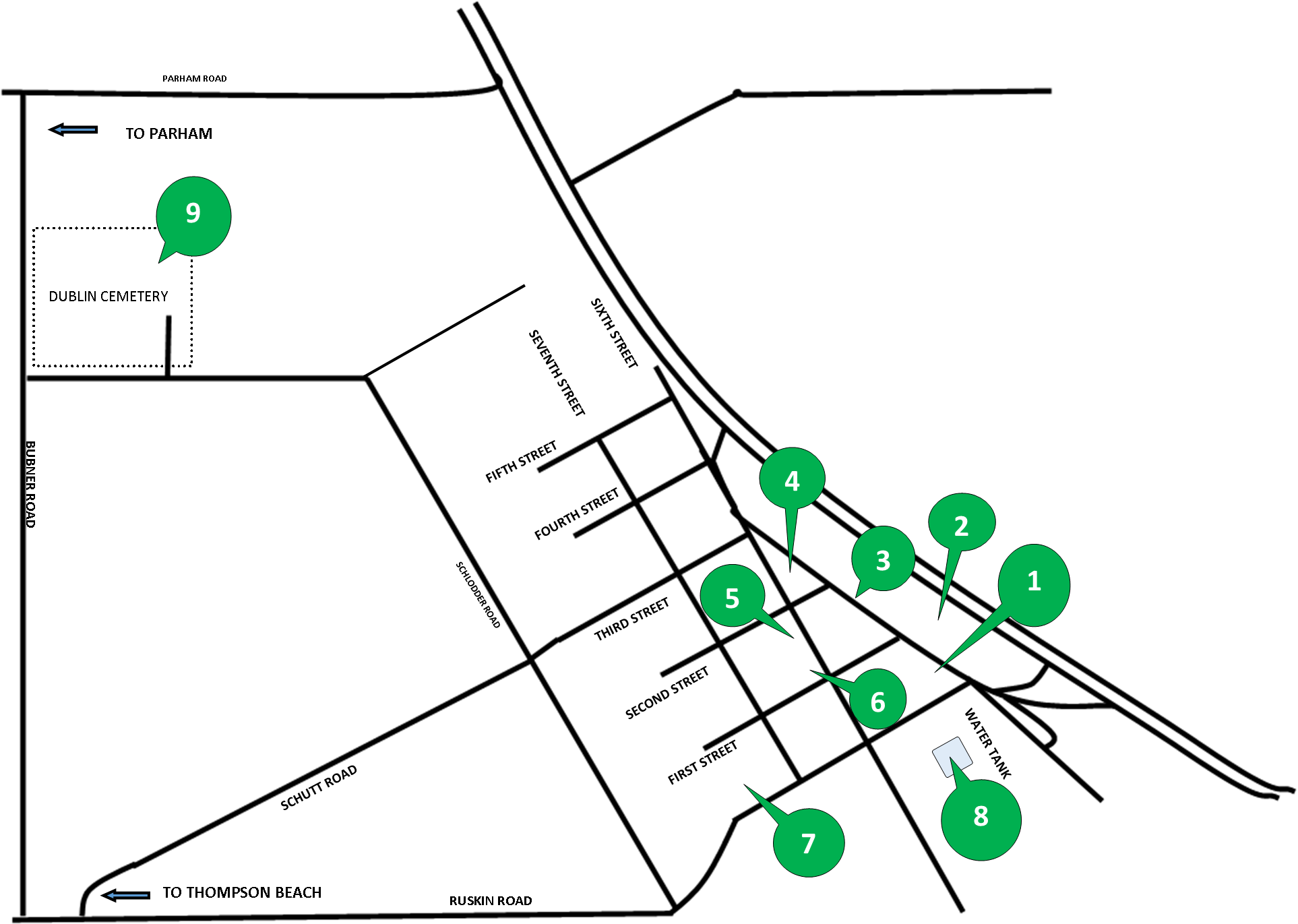
The Council Chambers were built in 1877 on block No. 49, Seventh Street.
The District Clerk for 1874 was Mr. Ralph Smith, and the first Chairman
was Mr. Richard Loveday. The first çouncillors were Messrs. Noble
Johnson, Weatherall Loveday, William Witson, John Lines, Richard Loveday
and George Arnold.
In 1935, the District Council of Light was formed out of Port Gawler,
Grace and Dublin District Council areas. In 1937, the name Mallala was
substituted for Light.
|