| |
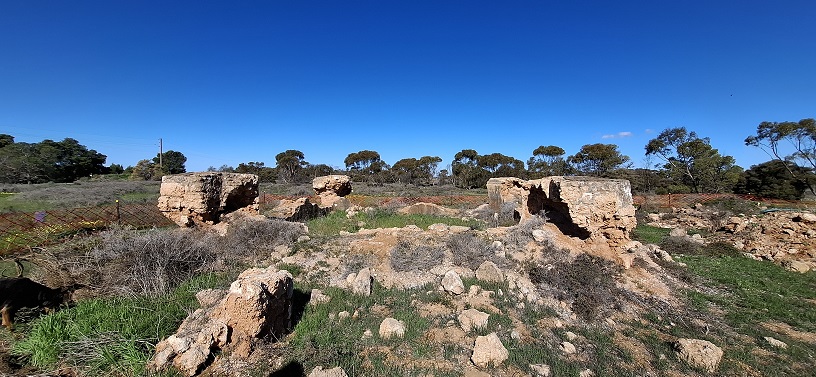
Preservation, (not restoration), of the Dublin Water Tank, (Well) on
the corner of South Terrace and Old Port Wakefield, Dublin. Yes it was
actually a Tank. Water was raised via a windmill and bore and pumped
into the “Tank”
The project is an initiative of the Dublin History Group dedicated to
preserving and recording the history of the area, (not just Dublin).
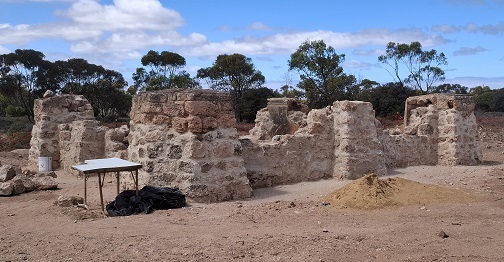
This project will assist Adelaide Plains Council to preserve, stabilise
and protect the feature, being the remains of the water well/tank, from
further damage and provide an historic statement. The Dublin History
Group are funding the project and volunteering labour. Dedicated local
builder Ross McLean is volunteering his knowledge, time and skills to
work with us. We would be open to donations of an old (non working)
windmill to give a full meaning to the display
It is not an aim to totally re-build the “Tank”, but to
preserve and secure what is there, with a view to showing what and how
it was used. It was originally the source of water for the area and
was considered very good quality which secured the establishment that
we see today. There will be a brief story board built into the site
which will direct viewers to obtain further information via a QRcode
to the DHG Website. In the mean time, progress will be documented and
uploaded to the group’s website page dedicated to the project.
A link can be found on the front page, www.dublinhistorygroup.com.au
After a number of meeting and discussions the project is about to start,
with assistance from the maintenance team of the Adelaide Plains Council.
Access will be restricted during the course of the work. So if you see
activity down at the old ruin over the coming weeks, this is what it
is all about. Please remember it will be a work site so stay behind
the marked perimeter.
Project Benefits:
• Preservation of a local historic site, town heritage –
telling the story of water in Dublin.
• Adelaide Plains Council working together with local community
group
• Community involvement - Local volunteers and suppliers
• Cleaning up the Town Entry visual statement
|
For many years the
artesian water wells of Dublin were the back-up water supply of the
Dublin community. As residents became more prevalent in the area, and
water tanks were installed on each property, the water was only basically
carted to water stock.
When the Barossa Water Corporation connected the mains water to the
area on Christmas Eve c1910, it was the best Christmas present the residents
could have ever received.
On August 22,1914 the windmill was sold to Mr H. Driscoll for the sum
of £2-0-0, prior to this Andrew Driscoll scaled the windmill structure
and removed the head as it had become unsafe. The towns people commenced
filling the wells with rubbish, in November 1914 Mr Driscoll was paid
10!- to fill in the wells.
In 1883 the price of water was 5!- per 400 gallons, stock water charges
were per head for cattle and per head for sheep.
|
|
| |
1871 Farmers making tanks
to catch water, no wells having been sunk
1879 February - SCARCITY
OF WATER. To the editor- Sir -Through the medium of your valuable paper
I wish, with your permission, to say a few words in reference to the
at present great scarcity of water in the Dublin Area. The evil with
which the selector has to grapple is a great one, and if rain does not
soon fall the farmers will be prevented from putting in their seed,
nearly everyone being engaged in carting water. for their stock for
a distance, in some instances, of twelve miles, which keeps them occupied
all the week round. Now I think that a great in justice is done the
selector - by the Government in not sinking-dams and waterholes in suitable
places.
1880 The Government dam is
drawing towards completion
1881 Residents think there
should be someone in charge of Government Dam so that the drains might
be looked after and water caught when it rains
1882 A number of residents
of Dublin, were introduced to the Commissioner of Crown Lands (Hon.
A. Catt) on Wednesday morning, by Messrs. W. Gilbert, M.P., and J. H.
Bagster M.P. The deputation brought under the notice of the Commissioner
the Government dam at Dublin, which it was stated was almost useless
from two causes— the first being that the pump (a No.6 Douglas)
was not powerful enough to draw the water from the dam, which had very
little in it; as although there was a very good fall the water was prevented
running into the dam by the grass and weeds. this state of things could
be remedied by sinking a well just outside the dam and erecting a pipe
to carry the water, or else by digging a scoop and a number of leaders
to take the water off. Mr. Catt, in reply, said that he would have a
report prepared on the matter of the pump, and as there were no drains
they would at once be cut, especially if, as the deputation had stated,
the dam could then be leased to any person who chose.
1883 Water supply clerk to
get pump put in thorough repair at District well and a reward to offered
for information convicting any person injuring the same.
The Government have settled the little difficulty about the Government
dam. For some time, past the drains leading to the dam have been found
insufficient for conveying the water, but a Government Surveyor has
recently been here and let the necessary work by contract. The dam at
present is about a quarter full
October - The contract for
clearing drains to the Government dam is completed, and the contractor,
Mr. J. Webb, has made a first-class job of it.
Sixteen reservoirs have been deepened or otherwise repaired and fenced
or fitted with the necessary appliances at the following places: —
Hundreds of Kulpara, Coonatto, Erskine, Wonna, Mundoora, Tickera, Bundey,
Minburra, Lindley, Dublin, Schomburgk, Yalpara, and Cavenagh, at a cost
of £1,613 Is., the present capacity of the reservoirs being 13,403,000gallons.
Wells are now being bored in the hundreds of Willowie, Dublin, Palmer,
Barunga, and Boolcunda. The total expenditure on all works within hundreds
during the year ending on June 30, 1SS3, has been £22,339 12s.
6d. inclusive of cost of transport. Borings are in progress at Dublin,
New, 247 feet;
1884 J. H. Hurst to have charge of the Government dam Dublin.
1885 February - The well
borers are still in the township working away, and it is to be hoped
they will get good water before the Government dam runs dry. There are
a good many carting water now, and there will soon be more. The bore
at the Government reserve is a good thing, and many are carting from
there now, but the drawback is that, the supply is bad.
March - A deputation, consisting
of the members for the district of Yatala, Messrs. W. Gilbert and J.
H. Bagster, and Messrs. Tench and West, waited on the Commissioner of
Crown Lands on Wednesday to ask that the necessary apparatus for raising
water at the Dublin tube well should be erected without delay. It was
suggested that a Halliday windmill and elevated tanks would be extremely
convenient, as by this means the residents would be able to get a good
supply of water without delay in the case of a water famine. The Conservator
of Water, who was present at the request of the Commissioner, pointed
out that there was a possibility of a windmill being brought to a standstill
when most wanted, 'and said he would recommend that a McComas water
lifter should be erected. The well had proved to be a very great success,
and as the water was of good quality he had no doubt there would be
a great deal of it used.
DUBLIN. February 28 1885
Our Government well-boring party in charge of Mr. Otto Sampson have
succeeded in giving us a splendid supply of water, and I can say that
without doubt it is one of the finest stock wells in the colony. They
had the steam pump at work without a stoppage for 48 hours, and the
supply did not diminish in the least. Mr. O. Sampson, who has charge
of the party, and Mr. C. Anthoney, the engineer, with the rest of the
party, have made themselves very much liked in the district by their
genial manner, and I am sure that when they leave this township, they
will take with them the good wishes of everyone. The splendid supply
of water will make Dublin the favourite route for stock travelling to
and from the north instead of Mallala, which up till now has been the
route
September - On Thursday morning Messrs. Gilbert and Bagster, members
for Yatala, with a deputation of residents in the District of Dublin,
waited on the Commissioner of Crown Lands (Hon. J. H. Howe) with reference
to the appliances at the Government Well, Dublin. Mr. Gilbert, in introducing
the deputation, said there was a pump at the well, which was not sufficient
for the requirements of the district. It was stated by members of the
deputation that the late Commissioner of Crown Lands had promised a
deputation about five months ago to have the necessary works carried
out. He had in the meantime sent up a pump which still remained. The
summer was now approaching, and at present it appeared that water would
be wanted more than at any previous time. The supply is unlimited and
only wanted the necessary appliances to fully meet the wants of the
district. The well which was an artesian one, had been put down on the
guarantee system.
1886 March - Mr. A. Felters
appointed caretaker of Dublin Well.
September – Dublin Council Clerk to have pump at Dublin well repaired
1887 February – Dublin
Council agreed to lease Dublin Well for another 12 months.
1888 April – Dublin
Council approved of chairman's action in ordering new pump for Dublin
well.
|
May - Messrs. Bagster and Gilbert to be asked to wait on Commissioner
of Crown Lands, and ask that Dublin well be handed over to council.
December - Council considered working of Dublin well, it being shown
that there was serious deficiency each year; it was decided to increase
charges for water to Is. 3d. per 400 gallons, Id. per head for cattle,
and 4d, per head per week for residents' cattle; 3s. 6d. per thousand
for sheep, and Government prices for all travelling stock, Mr. R. Carrier
was appointed caretaker of well and collector of water rates.
1889 March - Government offered
to reduce rent of Dublin well to £20 yearly
1894 March - PRESENT AND
PROSPECTIVE WELLS AND ARTESIAN BORES.
The importance of wells and artesian bores as first aids to development
has long been recognised, and various efforts have been put forward
by Water Conversation Department to provide a supply of water on stock
routes and at various centres. What has been done and what is now being
done we are now able to set out. In the following we first give the
locality, then the depth of the well, and the remarks refer to the quality
of the water: — Dublin Township, 212, good; Windsor Township,
392, stock.
1902 August - BAROSSA WATER
SUPPLY.
A meeting convened by the chairman of the District Council of Grace
(Mr. D. Wilson) was held at Mallala on Saturday to consider the advisableness
of asking the Government to extend the reticulation from the Barossa
waterworks to that locality.
C. Lindsay said he had been located on the boundary of Dublin and Grace
for33 years, and had carted water for 20 years. In. one week he. carted
6,000 gallons of water four miles. He very strongly advocated the reticulation
of the area. The rate of 4d per acre was nothing compared with the trouble
and expense of water carting.
September - BAROSSA WATER
SUPPLY. Dublin, August 4.
At the Dublin institute on Saturday evening a meeting was held for the
purpose of discussing the water supply question. The chair was occupied
by the chairman of the Dublin District Council (Mr. L. White), who convened
the meeting in response to a requisition. Mr. E.H. Coombe, M.P., was
present, and contributed information as to the conditions which the
Government had laid down in connection with the reticulation of the
district with water from Barossa. A plan was also exhibited by Mr. Coombe,
showing the contemplated routes for mains in the district. One main
would go to Shannon from Mallala, but up to the present Dublin was excluded.
A number of questions having been answered by Mr. Coombe, Mr. W. Prime
proposed That the Government be requested to arrange for this district
to be reticulated with water from Barossa. Mr. G. Long seconded the
motion, which was lost by 15 votes to 11. Reference was made to the
fact that several persons were present from Wild Horse Plains, who were
opposed to the water going through there, although they did not wish
to prevent the Dublin people from obtaining it. It was suggested by
Mr. Coombe that if those in the neighbourhood of Dublin desired to have
the water, they could probably secure it by obtaining the signatures
of owners and occupiers of land, between Dublin and Mallala, and petition
forms were taken for that purpose.
October - BAROSSA WATERWORKS
BILL.
The hundreds which would be supplied with water by these mains are Mudla
Wirra, Grace, Port Gawler, and Dublin; and the townships to reached
are Wasleys, Templars, Hamley Bridge, and Mallala, and also the neighbourhood
of Two Wells; and by utilizing the railway pipes already laid in Roseworthy
could be supplied with water as soon as a new main is laid through Gawler.
The reticulation of townships always affords a good return on the cost
of sub reticulation,
1904 October
The pipe carters are busy carting pipes for the Barossa water track,
from Mallala to Dublin
1906 November Opposition
Effectually Silenced. —
Actual experience of the benefits of the scheme has effectually silenced
opposition. The farmers. as a body, were not strong advocates of the
project; indeed, most of them were opposed to it. They were afraid of
the cost, and doubtful of the effectiveness of the undertaking. Even
after the headworks were finished and reticulation had begun some of
them opposed being brought within the influence of the mains. At Dublin.
for instance, a motion for the introduction of the water was defeated
by an adverse amendment. One settler in that neighbourhood declared
that if the water were brought, he would sellout and go elsewhere. Today
the township of Dublin shares the blessings of the Barossa system, and
the individual who threatened to leave has his farm supplied with the
precious fluid, and is more prosperous than ever before! Many who held
aloof at first, and were glad to see the principal mains going in other
directions because their neighbours were wiser than they, are now anxious
to be supplied, and it will be two or three years before some of the
requisitions being received can be complied with.
Dublin was now on mains water
1914
Windmill sold to Mr H Driscoll for £2, prior to this Andrew Driscoll
had scaled the windmill structure to remove head which had become unsafe.
Later that year Mr Driscoll was paid to fill in the well.
Over time the dam was used
by the local children for raft fun when full or go-carting in the drier
months. It would eventually be filled in with rubbish and now just earthworks
show the evidence of its existence
|
|
