| |
Dublin was first
surveyed in 1873 and this site was purchased that year by Charles young,
the land changed ownership many times and nearly one hundred years later
was purchased by Milton Schlodder.
the community recognised the need for a firefighting unit.
I n 1966 a corner of a block of land containing sheep yards and a shearing
shed was donated by Milton Schlodder to the district council of Mallala
for the construction of a fire station.
In September 1967 the emergency fire service fire station was opened,
the first members enrolled and Wednesday evenings nominated as training
night.
Ray George, the first EFS station officer, transferred from Mallala
in July 1968. he was followed by:-
Reg Clarke
Phillip Ferme
Gerry Applebee
Robert Collins
Gus Sanders
Terry Halford
The unit did more than just rural firefighting. training for road accident
rescue, general emergency response, hazardous materials clean up, the
use of compressed air breathing apparatus and newly developed equipment
such as the "jaws of life" made it one of the best trained
units in the state.
|
The first appliance was an
old Chevrolet fire truck transferred from the Mallala brigade. In 1973
that was replaced by an international c1500, an ex-council tip truck
converted into a versatile fire truck complete with water tank, petrol
driven pump, various hoses and nozzles, hand tools, knapsack sprays,
generator and spotlights.
The next unit was an Austin gypsy 4x4, transferred from two wells, useful
for fire fighting in sand dune country. originally driven overland from
England, it is now in the Birdwood car museum.
The next large appliance was designed and built by Dublin locals to
suit the local requirements for firefighting and as an emergency rescue
unit for serious road accidents.
In 1979 the organisations name was changed to the country fire service
(CFS) and in 1985, moved to a new home around the corner, again on land
donated by Milton Schlodder corner of First and Sixth Street. The original
CFS shed was dismantled and removed.
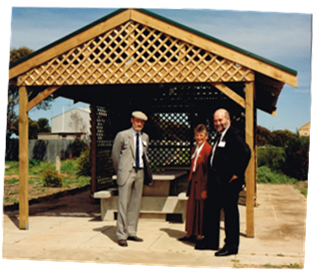
In 1997 a simple structure
was erected on the site to provide shade and shelter to travellers passing
through local organisations provided refreshments using the shelter
for sausage sizzles, for which Dublin became well known.
|
|
| |
UPGRADE
2015
saw an upgrade of the Schlodder Shelter. It was a collaborative project
between the District Council of Mallala and the Dublin History Group (DHG)
with funding provided by Bendigo Bank, the Department of Planning, Transport
and Infrastructure (DPTI), Council and the Dublin History Group and generous
donations made by members of the community towards the historical tiled
mural.
What originally began as an idea by the DUBLIN HISTORY GROUP to upgrade
the original timber shelter, became a major project, which saw it being
replaced with a steel framed, partially enclosed shelter, including a
wall purpose-built to showcase a tiled mural depicting the history of
the site.
The vision of the Dublin History Group to upgrade the site grew closer
when they secured a grant of $15,000 from the Bendigo Bank. At this point,
Council then advised they could contribute $5,000 (additional funding).
By sheer coincidence, at that time, DPTI announced a Local Government
Stimulus Program with funding available for projects which included community
facilities and streetscape projects.
Applications were sought from the Department of Planning, Transport and
Infrastructure (DPTI) Local Government stimulus Program for 'shovel ready'
projects. This enabled Council to apply for $20,000, matching funding
from which enabled the project to be completed in its entirety.
The venture included clearing the site including removal of vegetation,
demolition of existing infrastructure, excavation and laying of footings,
construction of the stone wall and installation of tiles.
The Dublin History Group oversaw the mural with tiles created by local
artists (Thanks Jackie) and fired locally, depicting the history of the
site through pictures and words, and embracing local families, community
groups and businesses.
The historical tiles offer a unique tourist attraction, with the shelter
serving the local and surrounding communities and businesses of the town,
and provides an ideal space for visitors to the area.
|
|
