| WINDSOR |
| |
|
PRINT
THIS PAGE |
|
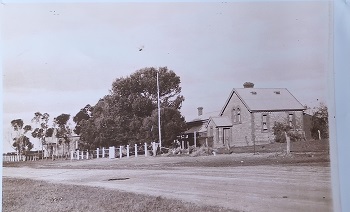
1. THE SCHOOL
The first school teacher
was Miss Julina Temby, a daughter of Mr W. Temby, the first storekeeper.
She used a room of the veranda at the store as a school room.
When the church was built, the school moved to the church and remained
there until the public school was opened in 1878. Mrs Ambrose was
the first teacher. She was followed by Miss Jenkin then Mr Ryder.
In 1882 Miss Alice B. Hinde was appointed.
|
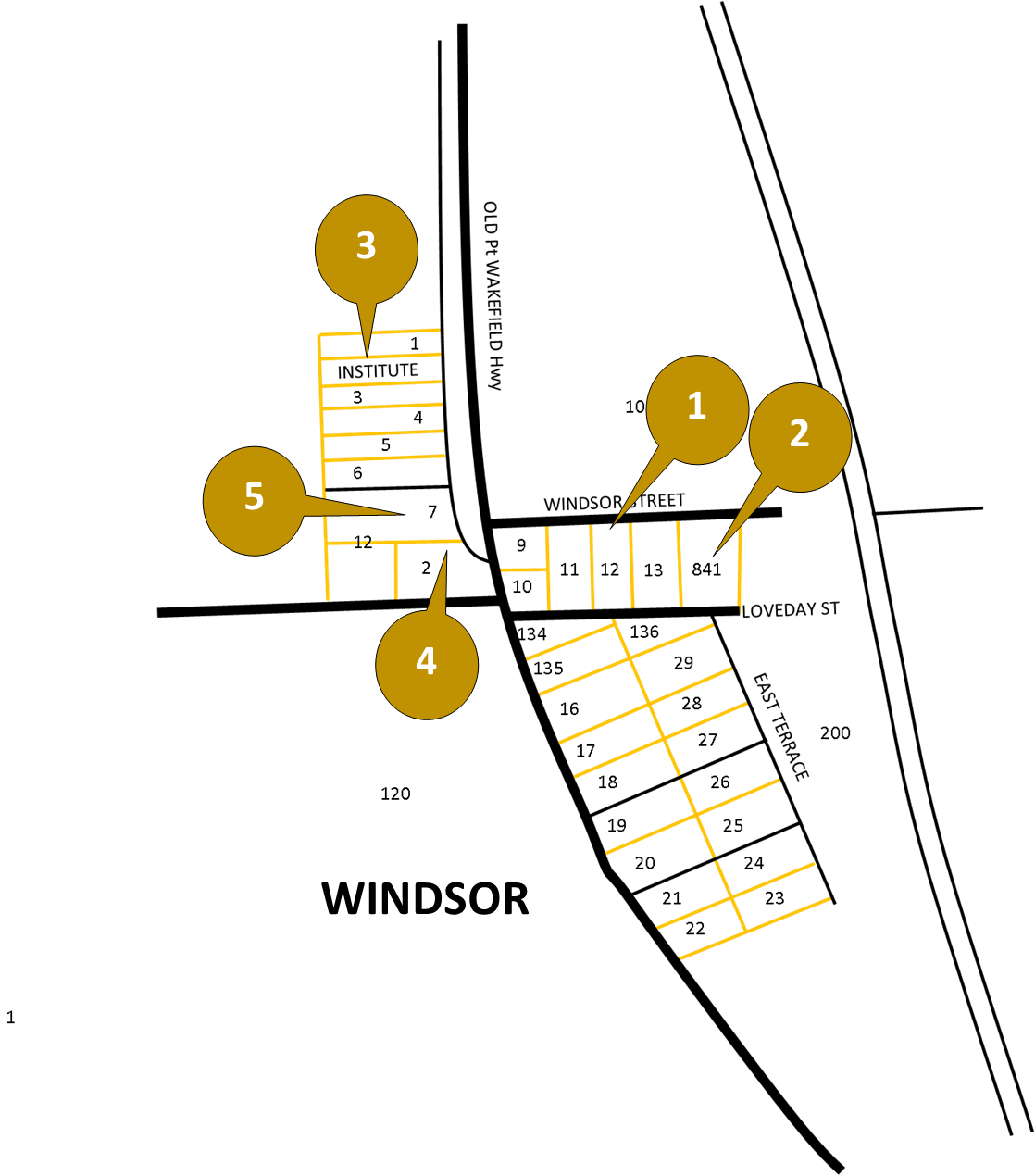
MAP
|
Welfare Club
The inaugural meeting was held 7 April 1964 with the following officers
elected: Lois Doeke, president; Dorothy Baker, secretary. Meetings were
to be held the first Tuesday in each month with a 2/- membership fee.
All mothers of children at the school attended this meeting.
Records show that strong support was given to the club with the teachers
and children benefiting by the addition of equipment (eg duplicator,
first aid kit, library books) and maintenance of library books, furniture
and grounds.
Fundraisers included trading tables, raffles, children's frolic, luncheons,
film evenings, fashion parades, garden party.
Members took advantage of all opportunities to learn more about current
educational trends, road safety, first aid, and all subjects pertaining
to their children's well-being.
Extract from Memories
of School by the Dublin History Group - Windsor School
By BERYL MARGARET SMITH nee ARNOLD
1924 - 1931
We three sisters rode a little white pony
called Nipper to the Windsor school. Later Dad bought a sulky and we
drove to school. The pony was given to us by my uncle Will Williams
who lived in the township. We always took a sheaf of hay for Nipper's
lunch but there was no water connected in the little yard at the back
of Mr Simmons blacksmith shop where we tethered Nipper while at school.
Mr Everett Senior owned the shop next door.
He told me _Don't worry about Nipper, the Lord will look after him'.
Mr Everett's housekeeper's name was Miss Lord and she gave Nipper a
bucket of water each day
Pupils from the Windsor School had to go to the Dublin school to sit
for their Qualifying Certificates. I remember going to Dublin in the
sulky with Nipper. After the exams. I went with a friend Mary Carter
to the Dublin shop for an ice cream ---a rare treat in those days. Bruce
and Doris Lock managed the shop and Doris made the delicious ice cream.
|
WINDSOR
SCHOOL 1929
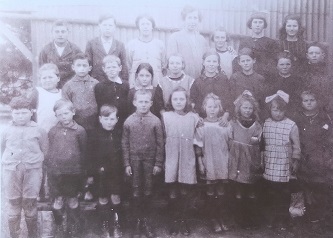
BACK ROW FROM LEFT
ALLAN REID HOWARD WILLIAMS EILEEN CROUCH TEACHER MRS WHI7TING710N
DOREEN ARNOLD DORIS CROUCH JOAN WHITTINGTON
2nd ROW FROM LEFT
JOAN MC ARDLE REX WHITTINGTON LESLIE CROUCH JOAN ATKINSON. MURIEL ARNOLD
MOLLIE WILLIAMS HILDA CROUCH GWEN CARTER CHARLIE A TKINSON
FRONT ROW
VINCENT MCARDLE GEORGE BAKER JIM CARTER DEAN WHITTINGTON MARNIE BAKER
ISOBEL CARTER BERYL ARNOLD MARY CARTER LILY RIED
|
|
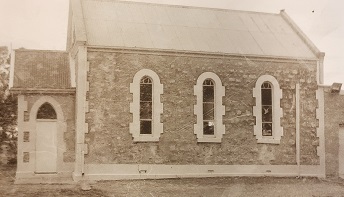
2. WINDSOR
CHURCH
The first church services
and Sunday school lessons were held in the residences of Mr Francis
Diment and Mr George Baker. On 30 September 1873 Sarah Ann, daughter
of George Emery Baker laid the foundation stone for the new Primitive
Methodist Church chapel. The building was completed and officially opened
on 21 December 1873 and formed part of the Two Wells circuit of the
Primitive Methodist Church, with Rev A. W. Wellington as the first minister.
Mr George Emery Baker, founder of the township, generously gave the
land on which the building was erected.
In the early years tea meetings and anniversaries were held regularly,
also lectures given on Monday evenings following anniversaries.
Mr Cheney's tender of L80.9.6 was accepted to add the front porch to
the building on 1910. By 1923 enquiries were made re a gas lighting
plant and in 1927 an additional light was installed over the rostrum.
The Ladies Guild had asked to have the boiler reconditioned and the
trust agreed to pay the expenses involved.
|
A new cement block toilet was
erected in 1952 and some 26 years later the toilet was modernised with
costs being shared by the church and the tennis club. A further upgrading
occurred in 1983 with costs shared again.
In 1958 a letter was received from the District Council of Mallala requesting
permission of the Church Trust to close Chapel Street (between the church
property and tennis club property) and transfer land to Windsor Tennis
Club.
MINISTERS
THAT SERVED AT WINDSOR
AFTER REV. JIM DAWES
MAY 1996 WINDSOR AND DUBLIN CHURCHES AMALGAMATED
REV TED BRAY
REV NEVILLE STEWART
REV JOHN WOODHOUSE
REV ROB SAUNDERS
REV KELVIN BENN
REV EVAN LASLETT - OWEN BASED
REV PHILLIP GARDNER
PASTOR DOUG WALLADGE
REV LLOYD KERLEY
REV FLO WALTERS
REV BRIAN POLKINGHORNE
REV JOHN WATTS
REV BRIAN SMITH
|
|
| |
3.
THE WINDSOR INSTITUTE
|
|
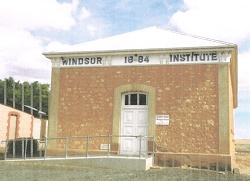
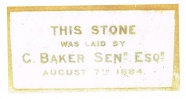
A very fast moving committee was formed
in June and by August 1884, the foundation stone had been laid by
Mr. George Baker who had donated the land for the School, Church and
Institute.
The stone was laid at 2.30pm and the social event was followed by
Dinner at 3.30pm and a Lecture at 7.00pm. "The proceedings for
the day resulted in £60 being added to the institute funds".
A contemporary newspaper report "....the walls of the building
are now 7 feet high; The building, which will measure 65 feet, by
27 feet and 16 feet high will be sufficiently large enough to answer
all the requirements of the district for many years to come. The cost
including the furniture will be about £500.0.0.
The official opening by the local MP for the division of Yatala, Mr
J H Bagster, was held on the 1 January, 1885. Mr Burton, the builder
from Gawler, had purchased one gross of lamps and wooden chairs, which
were assembled by Mr Schutt. By late 1885, a piano was purchased to
provide the music for balls, dances, socials and musical entertainment.
The newspapers also reported:-
"The building which faces the Walleroo Road, whilst not over
pretentious in its outward architecture, is a very neat design, being
built of limestone, with cement dressings, and is capable of seating
250 persons. At one end is a platform extending the width of the building.
On either side of the platform a room has been erected for the convenience
of performers. The whole structure presents the appearance of durability.
Light is supplied by means of four large windows, two on either side.
Two handsome chandeliers, of tree lamps each, supply light for evening
meetings."
"In the evening a concert was held in the new building, presided
over by Mr J H Bagster MP. The room was uncomfortably packed, which
caused the audience at times to be rather noisy. The babies were rather
troublesome, giving the singers all their work to be heard. The whole
concluded with a laughable farce by local talent, which would have
gone well had the characters known their parts better."
Prior to the evening concert, the lecture was delivered by the Rev.
W Jenkins of the Primitive Methodist Church with "The Gypsies"
the subject matter.
An amalgamation of the Adelaide Mechanics Institute, the Literary
Association and the SA Subscription Library occurred in 1856 to become
the South Australian Institute. Under the control of a Board of Governors,
this body was to include a Public Library and Museum, it was to conduct
lectures on a variety of subjects and also to include, by way of affiliation,
all of the Colony's cultural societies.
|
In 1884, after acting mainly for the Adelaide
community, the organisation was renamed the "Public Library,
Museum and Art Gallery" and then given the job of overseeing
the network of country and suburban institutes which had sprung up
over the previous thirty odd years. Also at this time, a new apd independent
body, the Adelaide Circulating Library, relieved the Board of
the business of circulating books on a subscription basis.
The Windsor Institute had a starting stock of books and added to them
as money became available. The reading room opened at 7pm and closed
at 10pm. Adjustments were occasionally made, like altering the start
time to 7.30 pm and the day of operation from Wednesday to Tuesday.
In 1887 it was decided to exchange library books with the Dublin Institute
and in 1891, the library started to loan books. In addition, the circulation
of book boxes had already been going for thirty years.
In the early days, it is not clear who managed the library for any
length of time except that Mr Diment, one of the original committee
members was noted as one of the first librarians. Mr White was librarian
for 3 years up to 1923, then Mrs Whitington 13 years to 1936, Mrs
C E Roberts 8 years to 1944, then Mrs Erica Baker from 1944 to 198339
years of service to the local community. Mrs Gwen Secomb then took
over from 1983 to 1996 with Mrs Dot leak filling in on occasions.
Then came Mrs Barbara Kennedy who after 22 years is still serving
the community today.
Many institutes considered the central body was not servicing their
interests and in 1898 formed a new association which became the governing
body for institutes throughout South Australia - but government assistance
continued to be provided through the Board until 1910. After that
the institutes Association was incorporated with the Public Library,
Museum and Art Gallery body, which then assumed responsibility for
the distribution of both books and subsidies. In 1939, the bodies
were separated again and the Association continued as the governing
body and the channel for government assistance.
In 1924 a "wizard" lighting was installed - 2 lights in
the hail and one for the stage. In 1935, a timely addition, a supper
room was added in time for the 50th Anniversary celebrations.
In 1955 a generator was purchased and three years later was upgraded
with a larger petrol tank to ensure it ran for the entire duration
of the function. Within 12 months of that, electricity came to the
district and when the power was connected, the Ladies Guild immediately
purchased an electric stove.
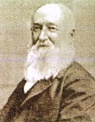
Mr George Emery Baker
|
|
4.GENERAL
STORE
|
|
|
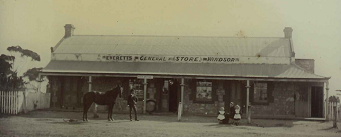
In 1884 Edward G Everett
purchased the Windsor Shop and Post Office and possibly four generations
of the family including Herbert A. Everett, H.H. Everett and C.H. Everett
owned and operated the business until 1946.
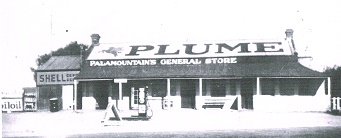
Mr C.H. (Charlie) Everett installed the petrol bowsers at the front
of the shop and built the shed so that he had a place to store the petrol
in the 44 gallon drums.
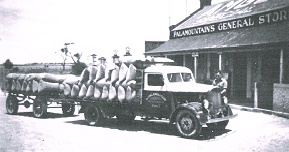
During 1946 William (Bill) Palamountain purchased the Windsor shop from
C.H. Everett following his discharge from service in the Royal Australian
Navy during World War Two.
In 1948 he married Kathleen Irish and together they ran the business
at Windsor until 1965. They worked hard to create a thriving business
and stocked most things required for daily living. As well as groceries,
fruit and vegetables, milk and meat, they also carried hardware, boots
and clothing.
Bill had a utility plus a trailer and he would go to Adelaide every
week to collect the fruit and veg and the groceries. Bill had a delivery
service of these items to householders in the
district.
|
They managed the Post Office
and also the telephone exchange which operated up to 10 pm each evening.
All this while rearing a family of four children.
Bill had a carrying business using two trucks, and with the assistance
of George Baker they delivered many services to the local farmers. Superphosphate
and petrol in 44 gallon drums were just some of the items that they
delivered. At times, they would also take a load of sheep to the abattoirs
for a farmer.
In 1965 Bill and Kath Palamountain sold the shop to R.M and S.M. Knox
and relocated to Gawler.
The "Life around the
Light - History of the Mallala District Council Area" published
in 1985, lists the following names as owners of the Post Office from
1877 to 1985.
William Temby, Francis Diment, William and sons James and Thomas Diment,
Herbert Havelock Everett, Charles Herbert Everett, William John Palamountain,
Robert Knox, Lancelot Wilby, George Hage, Barry Lee, Derek Seddon, Derek
Bladen, Roy Poole, Arthur Walter, Peter Waye.
Sources
• Mrs Kath Palamountain.
• Government of South Australia State Records.
• "Life around the Light" - A History of the Mallala
District Council area.
|
|
Other
Busnesses in Windsor |
|
|
Allotment 2
- Windsor Institute
Allotment 3 - Carpenter Alexander Thomas 25th February
188514th June 1888
Allotment 4 - Green Grocer
Mr William Bishop. 1st August 1881-31st 1885.
Thomas and Jonathon Hollams 31st March 1885- 19th July 1895.
Thomas Hollams 19th July 1895 —March 1908 William Robert Burnard March
1908 May 1911
Allotment 7 - Leonard Hamblin Burnard May 1911- Nov 1911
Blacksmith
William Simmons 15th August 1926. Purchased in February 1928 Mrs Arnold
Henry White used it for a garage.
Allotment 9 - Licensed Victualler John Parsons 7th October
1879 13th June 1884
Allotment 16 Thomas Bartlett June 1882.
Allotment 18 - 19 - 27 Undertaker & Carpenter James
Burton 1890 to 1912
|
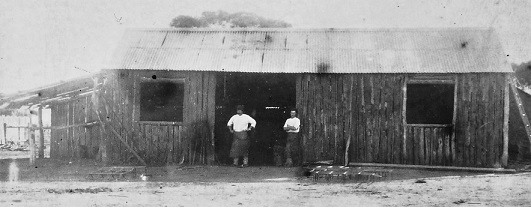
5. Blacksmiths Shop
William Simmons, 15 August-1926
Purchased in February 1928.
Mr Arnold Henry White used it for a garage
|
|
| |
|
|
|
| |
|
|
|
